Why Enhanced Rock Weathering May Scale Faster in Brazil Than in Europe

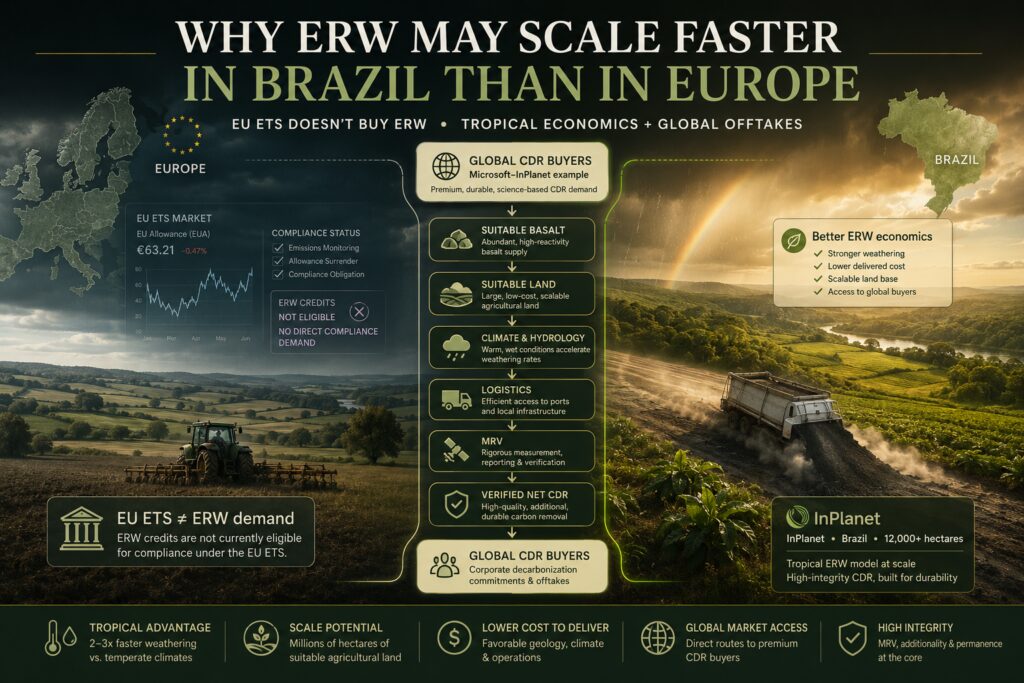
Europe has one of the world’s most advanced carbon markets, yet the EU ETS currently creates no direct compliance demand for ERW credits. Brazil, by contrast, combines tropical weathering conditions, large agricultural areas and potential agronomic co-benefits with access to global premium CDR buyers. InPlanet’s Brazilian model and Microsoft’s offtake strategy illustrate why ERW deployment may increasingly follow physics and economics rather than the geography of the buyer.
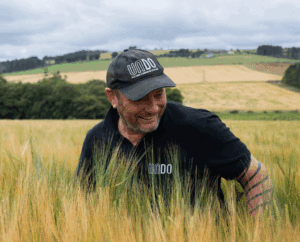
Flour Yield explains why Brazil is the better choice for Enhanced rock Weathering projects

What the EU ETS, Microsoft’s CDR procurement and InPlanet’s tropical ERW model tell us about the economics of carbon removal

Enhanced Rock Weathering (ERW) is often discussed as if access to suitable basalt were the principal constraint. It is not.

A commercial ERW project requires a combination of suitable rock, suitable land, favorable weathering conditions, manageable logistics, credible measurement and verification — and, ultimately, a buyer willing to pay for the verified carbon removal. That final factor deserves much more attention.

The emerging ERW market reveals an important geographic asymmetry. Europe has sophisticated climate regulation, strong scientific institutions and one of the world’s most developed carbon markets. Yet those advantages do not automatically make Europe the best place to deploy ERW commercially.

Brazil may currently offer a more compelling combination of physical conditions, agricultural scale, material availability and project economics.

And the buyer for Brazilian carbon removal does not have to be Brazilian. Microsoft’s growing procurement relationship with InPlanet illustrates precisely how a global ERW market may develop.


Europe’s Carbon-Market Paradox

Europe has perhaps the world’s most mature mandatory carbon market: the EU Emissions Trading System (ETS). But that does not currently create compliance demand for ERW credits.

An EU ETS operator must surrender EU allowances corresponding to its regulated emissions. Voluntary carbon-removal credits do not substitute for those allowances. The European Commission states that international credits are no longer EU ETS compliance units after 2020. That distinction is fundamental.

A steel producer, airline or industrial installation subject to the EU ETS cannot simply purchase an independently verified ERW removal certificate and use it instead of an EUA. For an ERW developer, this means that one of Europe’s strongest climate-policy mechanisms currently provides no automatic customer base.

The developer needs a different buyer: usually a company voluntarily purchasing durable carbon removal to meet a corporate climate commitment, neutralise residual emissions, address historical emissions or support development of the CDR market.

That is a much smaller and more selective market.


The EU Is Building Carbon-Removal Infrastructure — But ERW Is Not Yet Inside the Core Framework

Europe is nevertheless moving toward a more structured carbon-removal market.

The EU Carbon Removals and Carbon Farming Certification Framework — CRCF — is creating common certification rules. But the first permanent-removal methodologies adopted in 2026 cover only:

Direct Air Capture with Carbon Storage, BioCCS and Biochar Carbon Removal.

Enhanced Rock Weathering (ERW)  is not yet one of the approved permanent-removal methodologies.

This is relevant commercially.

The new EU CRCF Buyers’ Club is intended to aggregate demand and help connect buyers with certified projects. But its initial permanent-removal purchasing track is focused on the methodologies already approved under CRCF — again DACCS, BioCCS and biochar.

Even the European Commission’s 2026 proposal for the future EU ETS architecture points in this direction. The proposal envisages bringing certain domestic permanent removals into the ETS framework from 2031 by financing purchases of CRCF-certified DACCS and BioCCS removals. It also proposes a possible future role for high-integrity international credits from 2036. These are proposals for the future architecture, not the present compliance regime — and ERW is not among the named removal technologies in the proposed domestic ETS mechanism.

The conclusion is therefore straightforward:

As of 2026, an ERW project in Europe cannot build its commercial case around mandatory EU ETS demand.

It must largely compete in the voluntary durable-CDR procurement market.


Who Buys Durable ERW Removal?

This market exists, but it is unusual.

The strongest buyers are generally corporations with substantial emissions, ambitious climate commitments and the financial capacity to purchase relatively expensive long-duration carbon removal.

Microsoft is one of the most important examples.

The company has committed to becoming carbon negative by 2030 and explicitly treats carbon dioxide removal as part of that strategy. Its procurement criteria prioritise net-negative projects, scientific verification, lifecycle accounting and high durability. Microsoft specifically recognises mineralisation and ERW within its carbon-removal portfolio and has published buyer principles for responsible Enhanced Rock Weathering.

Microsoft has also become one of the world’s largest CDR buyers. Its public disclosures show tens of millions of tonnes of contracted carbon removals across a growing portfolio of technologies.

This reveals something structurally important about the emerging ERW market.

The natural customer may not be the industrial emitter located next to the project.

It may instead be a global technology company thousands of kilometres away.


The InPlanet Model: German Origins, Brazilian Deployment, Global Buyers

InPlanet provides one of the clearest examples.

The company was founded by Felix Harteneck and Niklas Kluger after their paths connected through Munich, Berlin and eventually Brazil. InPlanet describes its founding idea as emerging while the two travelled through Brazilian agricultural regions and considered how ERW could become a scalable carbon-removal business.

They did not build the operating model around Germany.

They built it around Brazil.

That appears increasingly significant.

In December 2025, InPlanet announced an agreement to deliver more than 28,500 tonnes of ERW carbon removal to Microsoft between 2026 and 2028. The removals are to be issued under Isometric’s Enhanced Weathering Protocol. At the time of the announcement, InPlanet said its Brazilian ERW programme covered more than 12,000 hectares of farmland. Its current website now also describes more than 20,000 hectares deployed.

The commercial architecture is revealing:

Brazilian farmland

locally deployed rock powder

tropical weathering

MRV and independent verification

durable CDR units

Microsoft as global buyer

This is not a regional carbon-offset model.

It is a global CDR supply chain.


Why Brazil?

InPlanet explicitly presents Brazil as an unusually favorable geography for ERW.

The company points to warm temperatures, substantial rainfall, large agricultural areas, abundant rock material, established farming infrastructure and an existing regulatory pathway for rock powders used as agricultural remineralisers.

The climate argument is especially important.

InPlanet states that tropical conditions can accelerate silicate weathering substantially compared with temperate environments.

The broader scientific literature supports the underlying direction, even if project-level performance must always be measured rather than assumed.

A global study published in Earth’s Future, modelling ERW across roughly 1,000 agricultural locations, found that ERW is substantially more efficient and reaches effective sequestration rates more rapidly in hot and humid environments, particularly in tropical regions. The authors also found significant amounts of basalt remaining unweathered over multi-decadal periods at less favorable sites.

This matters economically because ERW costs are incurred mainly on the input side:

rock sourcing, grinding, transport, application, monitoring and MRV.

Revenue, however, depends on the output:

verified net tonnes of CO₂ removed.

Faster and more complete weathering therefore improves the denominator against which deployment costs are measured.


Brazil Adds Something Else: Agronomic Value

The Brazilian model potentially has another advantage.

Rock powder is not necessarily being introduced into an agricultural system solely to generate carbon credits.

Brazil has a long history of research into rock powders and remineralisation, and rock powders can be regulated as agricultural remineralisers under Brazil’s agricultural framework. InPlanet specifically highlights nutrient-poor and highly weathered tropical soils as environments in which silicate rock applications can provide agronomic value alongside CDR.

That creates the possibility of two overlapping economic value streams:

soil and agricultural value

plus

carbon-removal value.

This is strategically important.

If a farmer sees agronomic value in applying the material, ERW deployment is not merely an external carbon-market intervention imposed on an agricultural operation.

It becomes potentially compatible with existing farming economics.

That is very different from a project whose entire business case depends on selling a carbon certificate.


Why Europe Can Be Harder

Europe may face almost the opposite configuration.

Many potential ERW locations have cooler temperate climates and more seasonal hydrology. Agricultural holdings can be comparatively fragmented. Labour, logistics and environmental-monitoring costs can be high. Material may need to travel significant distances. And the CDR output must still support expensive MRV.

None of these factors means European ERW cannot work.

But they raise the threshold.

An ERW project becomes particularly difficult when several disadvantages occur simultaneously:

slower realised weathering + high deployment cost + expensive MRV + fragmented land + no compliance buyer.

The result is a higher potential cost per verified tonne of removal.

This is why a European ERW project should not be evaluated simply on the availability of basalt or farmland.

The relevant metric is:

Cost per credible, verified net tCO₂ removed — combined with a credible route to market.


The Buyer and the Project Do Not Need to Be in the Same Geography

This may be the most important commercial insight.

Carbon-removal production and carbon-removal demand can be geographically separated.

Microsoft can purchase CDR generated on Brazilian farmland.

A European corporation could purchase CDR generated in Latin America.

A U.S. technology company could purchase CDR produced in Albania.

What matters to sophisticated buyers is increasingly not geographical proximity but quality:

credible additionality, high durability, robust lifecycle accounting, reliable MRV, environmental integrity and confidence that the contracted tonnes will actually be delivered.

Microsoft’s own CDR criteria emphasise precisely those characteristics.

This creates a global optimisation problem.

For the supply side:

Where can we produce the highest-quality verified tonne of CDR at the best risk-adjusted cost?

For the demand side:

Which buyer is prepared to contract that tonne at a price and duration capable of supporting project finance?

Those two answers need not point to the same country.


Europe Still Matters — Just Perhaps Differently

It would therefore be wrong to conclude that Europe has no role in ERW.

Europe can contribute scientific capability, mineral expertise, MRV development, environmental standards, finance, corporate buyers, technology, project structuring and regulatory infrastructure.

European field projects can also be valuable as research environments and proof-of-process deployments.

What is less certain is whether temperate European agriculture will always be the most competitive location for large-scale commercial ERW.

That question should be answered by evidence, not geography or corporate preference.

The rational project developer should therefore remain geographically agnostic.


A Different Way to Think About ERW Project Development

At Flour Yield, this leads us to an increasingly important principle:

Geography must earn the project.

A basalt reserve is not an ERW project.

Available farmland is not an ERW project.

A carbon methodology is not an ERW project.

Even successful measurement does not automatically create a commercial ERW project if there is no buyer.

The complete chain has to work:

Suitable Material

Suitable Land

Climate & Hydrology

Efficient Logistics

Controlled Deployment

Credible MRV

Verified Net CDR

Credible Buyer / Offtake

Economically Viable Scale

This is why we increasingly see ERW as a project-development discipline, rather than simply a carbon-credit technology.


Proof of Process, Proof of Economics, Proof of Scale

A useful development model may therefore involve three different stages.

A controlled European field can establish the process: material characterisation, baseline design, field application, data collection and MRV readiness.

A second geography can test whether that process works economically under more favorable land, climate and logistics conditions.

Only then does large-scale deployment become sensible.

In other words:

Proof of Process

Proof of Economics

Proof of Scale

Not every location needs to achieve all three.

That distinction can protect capital and improve scientific credibility.


What InPlanet Teaches the ERW Market

InPlanet’s development does not prove that Brazil is the correct geography for every ERW business.

But it illustrates a powerful principle.

The company did not insist on developing ERW where its founders came from.

It went to a geography where the physical and agricultural conditions appeared more favorable, built operational capabilities there, developed credible MRV and then sold the resulting environmental attribute to global buyers.

That is a sophisticated CDR business model.

The lesson is not simply:

Brazil is better than Europe.

The more useful lesson is:

ERW deployment should follow physics, agronomy and economics — while CDR demand can be sourced globally.


The Next Phase of GreenFi

This also has implications for GreenFi.

Financing cannot rescue a fundamentally weak project.

Tokenisation cannot make basalt weather faster.

A carbon marketplace cannot transform poor CDR yield into good unit economics.

And a strong environmental narrative cannot substitute for a creditworthy buyer.

The financing layer should therefore come last.

First comes the project.

Then the evidence.

Then verification.

Then market access.

Only after these elements align does financing become meaningful.

This is the approach Flour Yield intends to develop: connecting regenerative agriculture, basalt remineralisation, ERW project development, environmental data and GreenFi — but always beginning with the physical and economic reality underneath.

The central question is not:

Where can we spread basalt?

It is:

Where can basalt, land, climate, logistics, science and buyer demand combine to produce credible carbon removal at commercially viable cost?

The emerging Brazilian ERW market suggests that answering that question globally — rather than locally — may be essential to scaling Enhanced Rock Weathering.

And for Europe, that may be the most important lesson of all.


Flour Yield explains why Brazil is the better choice for Enhanced rock Weathering projects

Why Enhanced Rock Weathering May Scale Faster in Brazil Than in Europe

Europe has one of the world’s most advanced carbon markets, yet the EU ETS currently creates no direct compliance demand for ERW credits. Brazil, by contrast, combines tropical weathering conditions, large agricultural areas and potential agronomic co-benefits with access to global premium CDR buyers. InPlanet’s Brazilian model and Microsoft’s offtake strategy illustrate why ERW deployment may increasingly follow physics and economics rather than the geography of the buyer.

Read More »
Flour Yield token presents the Canadian carbon remover UNDO

UNDO: Scaling Green Carbon Removal with Quarry Networks

What if we could turn worn-out farmland into long-term carbon sinks — at scale? Enter UNDO, a Canadian climate-tech firm that just secured a major partnership with Barclays to remove over 6,500 t CO₂ via rock weathering. Here’s what they’re doing — and what Flour Yield is watching.

Read More »
LSEG research show strong momentum on the green finance section with Enhanced Rock Weathering

Green Investment Momentum Persists Despite Political Headwinds: The LSEG 2025 Report and ERW’s Blockchain Evolution

The London Stock Exchange Group’s (LSEG) latest “Investing in the Green Economy 2025” report delivers a powerful message to investors: despite political uncertainty and the new Trump administration’s climate policy retreat, the global green economy continues its robust expansion. This comprehensive analysis provides crucial insights for the emerging Enhanced Rock Weathering (ERW) sector, where Flour Yield Token is pioneering blockchain-enabled carbon removal.

Read More »
Fragen?