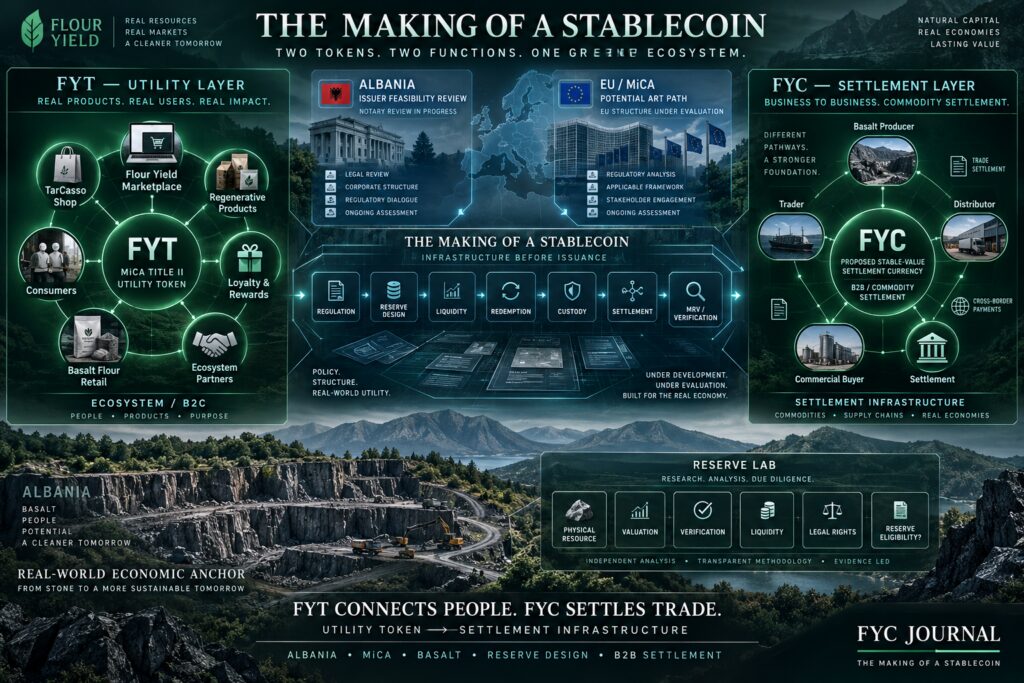
Where Flour Yield stands today — and why FYT and FYC are designed to do two very different jobs.
At Flour Yield, we describe the development of FYC as “The Making of a Stablecoin.” That wording is deliberate.
FYC is not a finished product and has not yet been issued. Its reserve architecture, legal structure, regulatory pathway and settlement model are still being developed and tested. Rather than presenting a stablecoin as a completed concept before these questions have been answered, we want to document the process openly.
At the same time, Flour Yield already has a token with a clearly defined role: the Flour Yield Token (FYT). The next stage of our strategy is therefore not about replacing FYT. It is about building a second, complementary layer.
FYT Today: The Ecosystem Currency
FYT is the existing Flour Yield utility token issued by Insela UAB. It is positioned under Title II of the EU Markets in Crypto-Assets Regulation (MiCA) as a utility token. Its purpose is straightforward: FYT is designed for participation in the Flour Yield ecosystem.
It can be used as an ecosystem payment and program currency for goods, services, access, rewards and other applications. This includes the Flour Yield marketplace and acceptance within the TarCasso ecosystem for products such as regenerative and longevity-related goods.
Importantly, FYT is not a stablecoin. It has no fiat peg, no fixed basalt conversion ratio, no guaranteed redemption value and no contractual claim on a reserve asset. Its market value can fluctuate. This separation is fundamental to the current MiCA Title II positioning of FYT.
In simple terms: FYT connects people with the Flour Yield ecosystem.
Why We Are Developing FYC
FYC — the proposed Flour Yield Coin (FYC) — starts from a different problem.
Global commodity trade still depends heavily on fragmented banking infrastructure, correspondent banks, multiple currencies, payment cut-off times and settlement processes that can be slow and capital-intensive. We believe blockchain-based settlement can eventually provide a more efficient alternative.
Our current vision is therefore to develop FYC as a stable-value B2B settlement currency for real-world commerce and commodity transactions. The initial focus is naturally connected to basalt.
Basalt is where the Flour Yield story started. It connects mining, agriculture, soil remineralisation, Enhanced Rock Weathering and potentially carbon removal. It also provides a real commodity flow around which settlement use cases can be developed. But the longer-term vision goes beyond basalt.
If the model works, FYC could potentially become a settlement layer for other commodity and sustainability-related value chains. The objective is not to build another speculative crypto token. The objective is to investigate whether a regulated digital currency can make real-world settlement faster, more transparent and more programmable.
Two Tokens — Two Different Functions
The emerging Flour Yield architecture can therefore be summarised as follows:
| | FYT | FYC |
|---|
| Primary role | Ecosystem and program currency | B2B settlement currency |
| Target users | Consumers, community, merchants, ecosystem partners | Businesses, commodity counterparties and institutional users |
| Current status | Existing MiCA Title II utility token | In development — not yet issued |
| Value model | Market-driven, no stability commitment | Intended stable-value architecture |
| Typical use | Purchases, access, rewards and ecosystem participation | Settlement of invoices and commercial transactions |
| Regulatory direction | MiCA Title II | Albania and EU/MiCA structures under evaluation |
| Asset relationship | No backing or redemption claim | Reserve and reference architecture still being designed |
There is no planned migration of FYT into FYC. They are intended to coexist because they solve different problems. A useful shorthand for our current strategy is: FYT connects people. FYC settles trade.
Basalt-Native — But Not Simply “Basalt-Backed”
One important lesson from our work so far is that the economic anchor of a stablecoin and its regulatory reserve are not necessarily the same thing.
The Albanian basalt resource is strategically important to FYC. It can provide commodity origination, real economic activity and potentially a reference point for the settlement network. But describing FYC today as simply “fully backed by basalt” would be premature.
A regulated stable-value token requires much more than a valuable physical asset. Liquidity, valuation, custody, segregation, redemption and reserve management must all work together. Under MiCA, for example, an Asset-Referenced Token must maintain a reserve of assets, that reserve must be legally and operationally segregated, and holders have permanent redemption rights. This distinction is central to our FYC Reserve Lab:
Value is not the same as liquidity.
The challenge is therefore to determine what role basalt should ultimately play — economic anchor, reference asset, reserve component, collateral layer or another legally defined function. That work is ongoing.
Why Albania Is Important
Albania has become an important part of our investigation for two reasons.
- First, the underlying basalt operations are located there. This creates a genuine connection between FYC and a real Albanian economic activity rather than establishing a token entity in an arbitrary jurisdiction.
- Second, Albania already has a statutory framework for digital assets. Law No. 66/2020 regulates, among other things, the issuance of digital tokens and virtual currencies as well as licensing and supervision of related market participants.
Our current concept is therefore to examine an Albanian company — FYC Albania Sh.A. — as part of the prospective issuer and operating structure. At this stage, however, this remains a feasibility project.
We have prepared an initial briefing and an Albanian notary is currently examining the proposed structure, including the distinction between an issuer and a licensed Digital Token Agent and the regulatory steps that would be required.
No FYC authorisation has been obtained and no final Albanian regulatory classification has yet been determined.
That is precisely why we call the project The Making of a Stablecoin.
Albania Is Not the EU/MiCA Route
There is another important regulatory distinction. Albania is an EU candidate country, but it is not currently an EU Member State. An Albanian authorisation would therefore not automatically create a MiCA passport for the European Union. For the EU market, the FYC architecture has to be considered separately.
Under MiCA, a crypto-asset that seeks to maintain a stable value by referencing assets or a combination of assets can fall within the definition of an Asset-Referenced Token, or ART. A MiCA ART intended for public offering in the EU would generally require an EU-established issuer and authorisation by the competent authority of its home Member State. Once granted, such authorisation can provide access across the Union.
For this reason, we are also examining a parallel EU/MiCA bridge, potentially involving an Austrian structure.
The precise relationship between the Albanian project, the commodity and reserve infrastructure, and a potential future EU-regulated issuer remains part of the design process. The objective is not to create two competing FYC tokens, but to identify a coherent structure that can connect the economic reality in Albania with regulated settlement markets in Europe and eventually beyond.
Building the Infrastructure Before Making the Promise
The dual-token strategy gives Flour Yield a clearer path forward.
- FYT already provides the ecosystem layer. It can connect consumers, merchants, regenerative products and community participation without promising stability or redemption.
- FYC is the next experiment: can a stable-value digital asset be built around real economic activity and ultimately become useful infrastructure for B2B settlement?
That question involves technology, regulation, reserve design, commodity economics, liquidity and commercial adoption. We do not yet claim to have all the answers. Instead, we intend to document the decisions, challenges and regulatory findings as the project develops.
That is what The Making of a Stablecoin is about. Not launching a token first and explaining it later.
Designing the economic and regulatory infrastructure first — and issuing FYC only if that architecture works.